Monday, August 28, 2006

Happy Anniversary

Oops, in my summer lassitude, I missed remarking on the anniversary of this blog. It was August 26,2005, when I made my first, somewhat tentative post. We were about to go to Lucerne, Switzerland, to see and hear our son, Chris, play with his string quartet, Jack, and the Lucerne Festival Academy Orchestra. (Chris just left yesterday for his third trip to Lucerne. Jack is playing again and Chris will be concertmaster of the orchestra, directed by Pierre Boulez again. We're not going this year because of our expected Korean trip next spring.) On previous trips abroad, I had inflicted my friends with mass emails describing the experience, and I thought a blog would allow those who wanted to read about the trip do so without bothering those who considered my emails spam.

It has been way more fun than I ever expected, even as the focus has shifted over the last year from a travelogue to observations about books, movies, politics and life. My dream had long been by this stage in my life to have retired to the southwestern United States, have purchased a small weekly newspaper and be writing outrageous editorials to stir up the locals. A blog is better. I can stay in a semi-metropolitan area that has an art theater, concerts and plays to entertain me, can still write outrageous pieces and don't have to worry about advertisers pulling their business. (Nevertheless, the Southwest maintains its romantic appeal to my imagination.) I have made many new friends, none of whom I have met in the flesh, but who drop by and leave comments and whose blog sites I keep track of. Many old friends have been kind enough to read my ramblings and leave comments, on the blog or by private emails. Thanks to all of you. Your feedback is what makes this effort worthwhile for me.

I would be remiss if I didn't comment on a couple of other recent significant anniversary mileposts. On August 12 and 13, about 130 of us gathered in Flint, MI to celebrate and renew acquaintances with people who had been there 40 years ago for one reason or another. For me and about 20 others, we had been there to do our public service in hospitals and Goodwill Industries as conscientious objectors. There were others who had just lived in the area and there were a significant number of girls who were there because there were a lot of single boys there. Flint in those days was a much more vibrant place than it is now, with a population about twice what it is now. (See Michael Moore's movie, Roger and Me for details, although things have gotten even worse since that movie was made in 1989.) I had not seen any of the people, except my three friends with whom I get together every October, and their spouses and another friend and his spouse in 40 years. This was a grass roots reunion, the idea for which my friends and I hatched up last October while drinking beer on a back porch outside Atlanta. We started out with hardly any contact information, put together what we had on a spread sheet and then started circulating the spread sheet to everyone who might know someone and gradually the names and addresses got filled in. We had a pig roast on Saturday evening, a concert by our friends, the Whitfords, who are also Flint alumni, and lots of visiting.
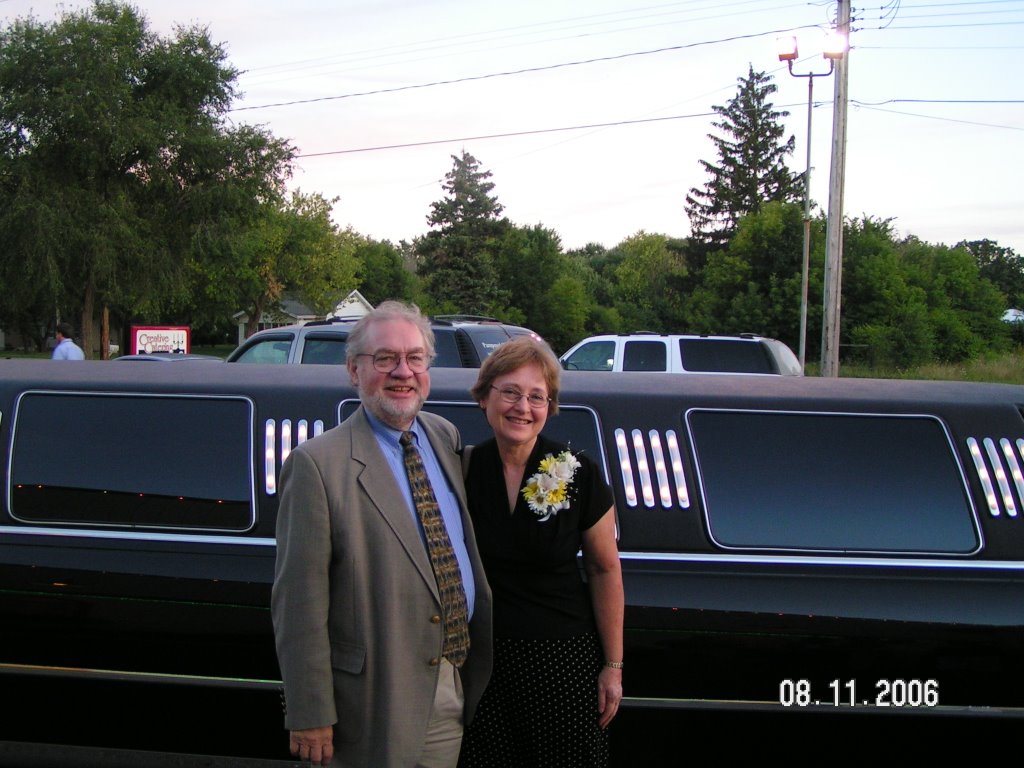
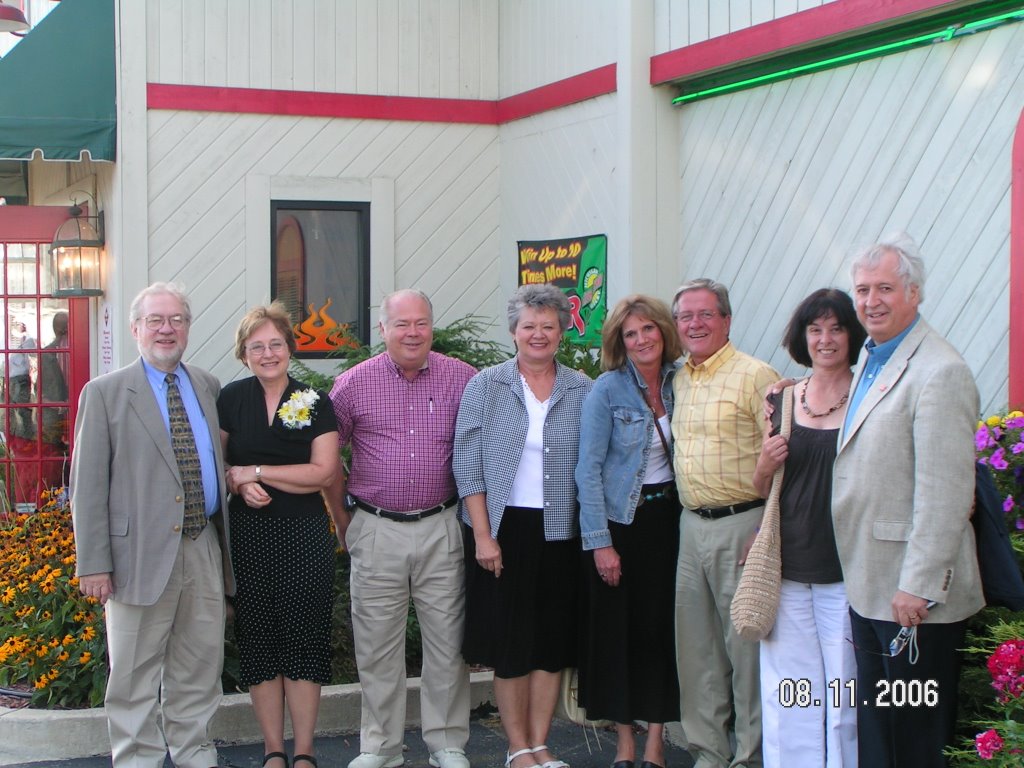
The Flint weekend was also the occasion to celebrate our 35th wedding anniversary. Our wedding was a small affair, in the back yard with only immediate family present. I think my wife has always missed the hoopla of a big wedding with legions of attendants. So, I decided to do hoopla for the anniversary and rented the biggest limousine I have ever seen to take our friends and us to dinner and dancing afterwards. These are our friends, Milt, Mary, Carlene, Marv, Donna and Earl. The men were all in Flint 40 years ago and stayed loosely in touch, but not as a group until two years ago when we started having annual get togethers. All of the men, except Earl, started out life as little Amish boys. At the reunion we sang a song called "Amish Country Blues," a parody of Folsom Prison Blues by Johnny Cash. The parody was originally done by The Electric Amish, a band which used to be on the Bob and Tom radio show out of Indianapolis. I added a couple of verses. Here is the text of the song and then I will conclude this too long post.
I hear that buggy coming,
It’s rolling round the bend.
And I ain’t seen a TV,
Since; I don’t know when.

I’m stuck in Amish country,
And time keeps draggin’ on.
And I won’t ever have call waiting,
I got no telephone.

When I was just a baby,
my Momma told me “Son,
Don’t ever use der engine
To make your buggy run.”
But I drove a car in Goshen
Just to watch it go.
If the preacher hadn’t caught me,
I’d be in Kokomo.

There’s lots of funky people,
Out there a driving cars,
Probably playing CD’s
And watching VCR’s.
But I guess I’m glad I’m Amish,
I got no bills to pay.
Still I wish I had a tractor,
To help me haul this hay.

When I turned 18,
My draft board told me “Son,
You’re gonna give me 2 years
No more having fun.”
But I got a job in Flint,
And soon the time went by,
And then I was a wondring,
Where did it fly.

Well I sold my horse and buggy,
And bought me a big screen TV,
I sat in my Lay–Z-Boy,
And watched MTV.
And I gained 50 pounds,
And had a heart attack.
If I had just stayed Amish,
I wouldn’t have to go back.

Oh, one last thing and then I'll go, I promise. Last week was the occasion of yet another anniversary, the anniversary of my birth, 60 years ago. I was born exactly nine months after my parents' wedding date. Please, don't anyone wish me a "Happy Birthday." I'm too old to enjoy the idea of yet another birthday having snuck up on me.

Sunday, August 06, 2006

Traditional Korean Wedding


One of my readers, gnightgirl, (if you haven't read her blog, This Just In you absolutely need to go there and scroll down to read about how she got rid of an overly-friendly drunk in downtown Champaign last week) wonders if my wife and I are going to Korea for our son's traditional Korean wedding next spring. Absolutely! We're even going to rent traditional Korean wedding costumes for the occasion, and I'm going to memorize the traditional Korean blessing recited by the groom's father. I'm not sure what the parents' costumes look like, but Bomina sent us a picture of how the bride and groom dress (photo left). I'm sure our costumes will be along the same lines, except that I will look distinguished, not goofy. One can always hope. Or wish.

Saturday, August 05, 2006

Drug-Taking Mennonite Gets Busted

It was big news in Amish and Mennonite communities a few weeks ago when beer-drinking Floyd Landis appeared to have won the Tour de France. Even Landis's devout parents who wouldn't miss church to watch the race on their neighbors' television and who festooned their lawn with "Give God the glory," signs were not immune to the hype. Although God was to be given the glory, they had one sign proclaiming "Floyd's the man."

Now it turns out God wasn't responsible for the glory after all; it was synthetic testosterone that gave Landis the strength for his super-human effort in the race. I'm curious what the signs on the Landis lawn say now: "Don't blame God?" (I must say God has worked his gig pretty well. He gets the credit whenever anything good happens; whenever anything bad happens somebody else gets blamed. I see why George Bush decided to get religion.)

If I sound bitter, I am.

Friday, August 04, 2006

Jeremy and Bomina

Our oldest son, Jeremy, came back from South Korea this week after teaching English over there for four years. We were glad to get him back, particularly after reading the day before he left about the North and South Korean armies trading shots again over the demilitarized zone. He was treated very well by his employer, BCM Educational Group, but he is ready to get on with the next phase of his life, which includes getting his computer network certification at our local community college and then bringing Bomina here to the States to join him. Jeremy and Bomina have been dating for nearly two years and their plans had been for him to go back to Korea next May or June and to get married in a traditional Korean wedding. They decided it would be easier for Bomina to get her visa if they were married now, so they got married in a civil ceremony a few weeks ago, but will still do the traditional wedding next spring. Meanwhile, poor children, they will have to be apart for 10 months, although hopefully, Bomina will be able to come here or Jeremy visit Korea around Christmas time. Bomina is a sweet girl and I think they will be very happy.

Sunday, July 23, 2006

Beer-Drinking Mennonite Wins Tour de France

Like most Americans, I don't really follow bicycle racing. But I have been following this year's Tour de France with a little more interest since Floyd Landis, the beer-drinking Mennonite from Lancaster, PA has been in the headlines. It's nice to see that an ultra-religious background and a fondness for beer and pizza are not insurmountable handicaps to getting to the top of at least one profession.

Wednesday, July 19, 2006

The Questions Are

Here is a list of the searches that brought readers to my blog over the last four days. A few might have found what they were looking for. In many cases, I imagine they were disappointed. If any wander back here, I would love to hear from them.

* two and one-half men cast
* footnotes for Silas Marner
* 27s not me whom
* discipline in a student life wikkipedia
* david bordwell
* mrs henderson presents barber
* amish
* joi hofsommer
* ruth irene garrett
* oprah winfrey sold Kirby vacuum cleaners
* classic book reviews jane austen
* the grapes of wrath john steinbeck 600 pages
* silas marner tape
* swartzendruber amish
* meadowbrook park garden plots
* worst analogies
* crockhead abroad
* review guy debord revolution in the service of poetry
* tillie carrier deck

Monday, July 17, 2006

Ask Aunt Tillie: Do Amish cuss?

Dear Aunt Tillie:

My son, a high school senior, has a job this summer working on an Amish construction crew. I was excited about the job because I thought he would pick up wholesome habits from his Amish co-workers. Instead, I find out that he is learning new curse words. Do you think these are really Amish boys that he is working with or are they just masquerading as Amish? Amish don't use curse words, do they?

Concerned Mother.

Dear Concerned Mother,

I guess you have never taken a hammer in hand and hit the wrong nail. No, theoretically, Amish do not cuss. The preachers in our churches do not tell us, "Go ahead and cuss when you have to; it's okay." On the other hand, most Amish work with their hands. When you work with your hands all day, they will, occasionally, be in the wrong place at the wrong time. What do you say when you're slicing a loaf of bread and nick your thumb, or pinch your finger in a drawer?

I have often wondered whether Jesus actually worked as a carpenter, as we are led to believe, or whether maybe he was the guy in charge of making estimates, drawing plans, ordering materials, etc. I don't see how he could have remained sinless if he was actually out there in the hot sun swinging a hammer and sawing a 2x4. Even the Son of God would have said "Son of a $%#&! if his hammer had hit his thumb instead of the nail. Actually, I guess they didn't have nails 2,000 years ago, he would have been hammering on a wooden peg. A peg is a lot bigger than a nail, so maybe he never missed his mark. That must be it; he was perfect, after all. It's a good thing he was born then and not now; he would never have kept perfection going for 30 years.

Aunt Tillie

Sunday, July 16, 2006

World's Worst Analogies

Okay, so this isn't exactly original, but the tank still hasn't filled up yet. An anonymous friend sent me these analogies, which are floating around the internet. They are attributed to The Washington Post Style section, but I don't know if they actually came from there. They did make me laugh like a chicken would laugh if it had a sense of humor.

Every year, English teachers from across the country can submit their
collections of actual analogies and metaphors found in high school
essays. These excerpts are published each year to the amusement of teachers
across the country. Here are last year's winners.....

1. Her face was a perfect oval, like a circle that had its two sides
gently compressed by a Thigh Master.

2. His thoughts tumbled in his head, making and breaking alliances like underpants in a dryer without Cling Free.

3. He spoke with the wisdom that can only come from experience, like a guy who went blind because he looked at a solar eclipse without one of those boxes with a pinhole in it and now goes around the country speaking at high schools about the dangers of looking at a solar eclipse without one of those boxes with a pinhole in it.

4. She grew on him like she was a colony of E. Coli, and he was room-temperature Canadian beef.

5. She had a deep, throaty, genuine laugh, like that sound a dog makes just before it throws up.

6. Her vocabulary was as bad as, like, whatever.

7. He was as tall as a six-foot, three-inch tree.

8. The revelation that his marriage of 30 years had disintegrated because of his wife's infidelity came as a rude shock, like a surcharge at a formerly surcharge-free ATM machine.

9. The little boat gently drifted across the pond exactly the way a bowling ball wouldn't.

10. McBride fell 12 stories, hitting the pavement like a Hefty bag filled with vegetable soup.

11. From the attic came an unearthly howl. The whole scene had an eerie, surreal quality, like when you're on vacation in another city and Jeopardy comes on at 7:00 p.m. instead of 7:30.

12. Her hair glistened in the rain like a nose hair after a sneeze.

13. Long separated by cruel fate, the star-crossed lovers raced across the grassy field toward each other like two freight trains, one having left Cleveland at 6:36 p.m. traveling at 55 mph, the other from Topeka at 4:19 p.m. at a speed of 35 mph.

14. They lived in a typical suburban neighborhood with picket fences that resembled Nancy Kerrigan's teeth.

15. John and Mary had never met. They were like two hummingbirds who had also never met.

16. He fell for her like his heart was a mob informant, and she was the East River.

17. Even in his last years, Granddad had a mind like a steel trap, only one that had been left out so long, it had rusted shut.

18. Shots rang out, as shots are wont to do.

19. The plan was simple, like my brother-in-law Phil. But unlike Phil, this plan just might work.

20. The young fighter had a hungry look, the kind you get from not eating for a while.

21. He was as lame as a duck. Not the metaphorical lame duck, either, but a real duck that was actually lame, maybe from stepping on a land mine or something.

22. The ballerina rose gracefully en Pointe and extended one slender leg behind her, like a dog at a fire hydrant.

23. It was an American tradition, like fathers chasing kids around with power tools.

24. He was deeply in love. When she spoke, he thought he heard bells, as if she were a garbage truck backing up.

Saturday, July 15, 2006

A Dry Tank

This is from Ron Powers' biography, A Life: Mark Twain regarding Twain's promise to his publisher to write night and day and send 200 pages of manuscript a week on the book he was struggling with, which eventually came out as Roughing It:
He was kidding himself. He was in no shape to write night and day. His creative interest in the book had stalled, a recurring affliction that Mark Twain eventually came to understand metaphorically as his "tank" running dry. He also came to understand -- later-- how to deal with the "dry tank": put the manuscript aside and wait, for months or years, until the tank filled up again.

Some people have been asking what has happened to my blog; am I okay? I'm okay. My "tank" will fill up again when it fills up. I just hope it isn't months or years.

Sunday, June 25, 2006

Movie Report: Look Both Ways

I can't think of another movie that deals with the inevitable end of us all with the frankness and grace of Look Both Ways. The movie, written and directed by an Australian woman, Sarah Watts, is about the way five people deal with death during one weekend in Australia.

The main characters are as follows: Meryl is an illustrator for a greeting card company and an artist, who, on the way home from her father's funeral, witnesses a man hit by a train while trying to save his dog. Nick is a news photographer, who, right after finding out that he has testicular cancer which has metastasized to his lungs, brains and other parts of his body, is sent out to the accident scene to take pictures. Andy is a depressed reporter for the newspaper and is convinced that many deaths that appear to be accidents are actually suicides. Anna is the widow of the man killed in the train accident. And Phil is the engineer of the train that struck the man.

The movie illustrates what a difficult subject death is, when dealt with honestly. No one, in the movie or real life, wants to seriously consider their own demise. I will always remember, 30 years ago, a week before my father died, a fervent Christian convinced that he would go to heaven, a place of unimaginable bliss, talking about his estate, "in case something would happen to me." I was thinking, but, of course, didn't say, "What are you talking about, 'in case,' Dad? You're on your death bed." What I didn't know, and will never know, is whether he was actually thinking "in case," or was using euphemisms to spare my feelings. When I received my own diagnosis of paranasal sinus cancer about three and a half years ago, while waiting to find out my prognosis, I was determined to be forthright and unflinching. It was much easier not to flinch after I learned that my tumor had been caught at a very early stage, surgery would make me better than new and there was a very low probability of the tumor returning.

I thought the movie was exceptionally well made. We see what Meryl is thinking and fearing through the device of animated scenes in the style of the paintings she makes. We see what Nick is thinking and fearing through the device of photographs. Although the movie deals frankly about death, none of the characters really wants to think about it. Although the subject of the movie is morbid, the movie manages to avoid being overly-sentimental and mawkish.

The end of the movie, an epilogue, really, without being labelled as such, consists of a series of photographs that appear to say what happened next, but, as some reviewers have noted, may only be what Nick envisioned happening next. In any event, the end is a little more concession to commercial considerations than to reality for my tastes, but it doesn't spoil the movie.

I don't know if the subject matter will keep people from watching this movie, but it ought not. If the public was willing to watch something maudlin like Love Story which was nominated for Best Picture, then it certainly shouldn't be bothered by Look Both Ways. Although about a difficult subject, this movie is never depressing or sentimental.

My main problem with this movie, as with so many British and Australian movies, is that some of the accents were so thick as to be virtually undecipherable, although this was not true for most of the main characters. I found myself wishing at times that the movie was in a foreign language, so that it would have subtitles and I would know what the actors were saying. But that was a relatively minor complaint and I gave the movie four and one-half stars, shy of the full five stars because of the difficulty in understanding at some parts and the feel good epilogue.

Wednesday, June 21, 2006

Movie Report: A Prairie Home Companion

I thought A Prairie Home Companion was a good movie, better than the average Hollywood movie, but not a great movie, and gave it four stars.

This will draw the wrath of the self-appointed police of movie criticism who can bear no deviance from the New York literati orthodoxy. Robert Altman is a great director, goes the literati's auteur analysis. Great directors make great movies (or "films" as the literati like to say.) Robert Altman made A Prairie Home Companion. Ergo, A Prairie Home Companion is a great movie. On the converse side, Ron Howard played Opie on the television series, Happy Days. Happy Days was a popular and therefore, insubstantial, series (as would be any television series with the word "Happy" in it.) Ergo, Ron Howard is a bad movie director. Ergo, any movie made by Ron Howard, such as A Beautiful Mind, must be a bad movie.

These "movie police" enforce the ordinances and statutes of The New York Times, The New York Review of Books and The Village Voice. Frank Rich is their chief. When Rich makes a pronouncement, his minions bow three times and go forth to do likewise.

I hold no brief against Robert Altman. I loved Nashville and Short Cuts. I like to listen to Garrison Keillor and his radio show, A Prairie Home Companion, if I remember and am not otherwise engaged. The highpoints of the radio show are Keillor's monologue, a long, rambling account of happenings in the fictional "Lake Wobegon" and the goofy radio dramas with characters; Guy Noir, Lefty and Dusty, the cowboys. Keillor is a genius at what he does; no other radio program comes close to duplicating his schtick.

The problem with Keillor is when he goes outside the entertainment genre in which he excels. I have read several of his novels and he is not a great novelist. Nor is he a great movie writer. The plot of the movie, A Prairie Home Companion is so thin as to be virtually non-existent. The movie is supposedly the last broadcast of the radio show, brought to an end because a rapacious Texan has bought the Fitzgerald Theater, home of the show when it is in St. Paul, and plans to tear it down. But that makes no sense because the show is frequently on the road; there is nothing unique about the Fitzgerald that would put an end to the show if it couldn't have the theater as its home base.

Then there is the problem of Guy Noir, a fictional detective played by Keillor on the radio program, who suddenly is a real person, the head of security for the show, played by Kevin Kline, in the movie. A mysterious woman dressed in white glides around the stage and dressing rooms in the movie, but it is never clear exactly what she is doing. The consensus seems to be that she represents death, as a character dies in her presence, but then she returns, and no one knows for what or whom.

Keillor plays himself, but doesn't do the famous monologue, the strongest part of the radio show. Although several of the fake commercials are shown in the movie, there are no dramas; Lefty and Dusty becoming strictly singers, who don't sing all that well. Lily Tomlin and Meryl Streep appear as an aging pair of singing sisters, and they are always a delight to watch. They do their own singing in the movie and do an amazingly good job. Then there is a teenager who writes suicidal poetry played by Lindsay Lohan, apparently a television star, but whom I have never seen nor heard of. The movie criticism police applaud her performance, apparently contrasting the character she plays in this movie with whatever she plays in other movies, but, like the direction, I think it should stand on its own. If one has to evaluate a performance by comparing it with other things that director or actor has done, then it doesn't seem like much of a noteworthy performance to me.

The major problem with the movie is that by its very nature it destroys the very thing that makes the radio show great, i.e. the fact that what is going on is NOT seen; it happens largely in your imagination. Radio sound effects lose their effect when you can see that the sound of horses galloping is not coming from actual horses galloping but a guy banging together some blocks of wood.


So, with all my criticisms, why am I giving this movie four stars instead of three? Well, it is not a typical Hollywood movie. There are no gun battles, car chases or sex scenes. It is a sleepy film about a sleepy radio show. It gives a nice, although probably fictional, view of the behind-the-scenes of a radio show that I like -- somewhat. On the other hand, if you've ever seen one of the televised broadcasts of A Prairie Home Companion on public television, then you're probably been entertained as much as you would be by seeing this movie.

Monday, June 19, 2006

Movie Review: The Sting

My friend and Chief Critic, pg, is constantly berating my "movie reports" as uninformed, superficial and not worthy of the time it takes to write and read them. Other than that, pg likes my writing. Friday night, I went to see the grand old movie, The Sting, a movie classic, which was shown in our classic theater,The Virginia Theater. To satisfy, pg, I have decided to do a real movie review, worthy of the name and the time. So read and enjoy, pg. The rest of you might want to come back some other time for something a little more readable.

The Sting is a movie about an elaborate con game, but at a deeper level the movie itself is an elaborate con of the audience. It was made in 1937 (you can tell by looking at the automobiles) but held by the studio, Sony Pictures, for nearly 40 years until the time was ripe for its release. More remarkably, the lead actors, Robert Redford, and Paul Newman, were only one year and 12 years old, respectively, when the movie was made. They were made to look 25 and 37 years old, respectively, through an extraordinary makeup job by the great Henry Bumstead, no relation to the famous Dagwood Bumstead of Blondie comic book fame. In a little-known fact, a stunt man, John Scarne, doubled for Paul Newman's hands during the famous card shark scenes because Newman was actually pretty clumsy at cards. Even more amazingly, the famous stunt man, Mickey Gilbert, (no relation to the famous cartoon character, Mickey Mouse) did all of Redford's walking scenes, as Redford, at the time the movie was made, was still getting around by crawling. Redford didn't need a stand-in for his standing scenes, having just mastered the art of standing two weeks before shooting started. (The practice of using "stand-ins" for actors too young to do their own standing dates from the earliest days of film.)

But what makes the movie great is its innovative use of the French theorist,Guy Debord's concept of the "society of spectacle." Debord was only six years old when The Sting was made but became acquainted with its director, George Roy Hill, when he was four, attending a day care in the Sixth Arondissement in Paris, run by Hill's parents. Debord was a leader of the "Situationist Movement," and even wrote a book and made a film about situationism, although neither was nearly as successful as the prime example of situationist movie-making, The Sting. Debord's first book, Memoires, written when he was in kindergarten, was bound with a sandpaper cover so that it would destroy other books placed next to it.

For Debord, spectacle unifies and explains a great diversity of apparent phenomena. As he said in a much-quoted passage, "The opposition that must now be united against this ideological decomposition must not get caught up in criticizing the buffooneries appearing in outmoded forms like poems or novels. We have to criticize activities that are important for the future, activities that we need to make use of. One of the most serious signs of the present ideological decomposition is that the functionalist theory of architecture is now based on the most reactionary conceptions of society and morality. That is, the temporarily and partially valid contributions of the original Bauhaus or of the school of Le Corbusier have been distorted so as to reinforce an excessively backward notion of life and of the framework of life."

The noted film critic, Kevin Sweeney, however, criticizes the Debord approach to film making as exemplified in The Sting. In an epoch-making epistle, he said, "In recent years, film theory has seen the emergence of a cognitive theory of narrative comprehension and interpretation. The theory arose from a dissatisfaction with poststructuralist theories of narrative that emphasize the film viewer's unconscious or ideologically coded responses to screened images. Rejecting this Lacanian-Althusserian model of film narration and viewer response, cognitivists such as David Bordwell, Edward Branigan and Noel Carroll analyze cinematic comprehension in terms of active viewers' ordinary psychological processes and strategies of problem solving. Narrative film viewing, they claim, consists of the same sorts of top-down (conceptualizing and inferring) and bottom-up (sensory, data-driven, automatic) psychological processes that perceivers use to understand events in the world around them." Sweeney refers to this general theory as "cinematic cognitivism."

I personally think that Sweeney is too quick to reject the Lacanian-Althusserian model of film narration and viewer response. As shown by the opening shots, in The Sting of a spiffy pair of shoes walking through depression-era Chicago streets, there is still life in the Lacanian-Althusserian model. The switch of the money in Redford's pants, when he is still a street grifter, is another example of Lacanian-Althusserian cinematography at its finest. (Another little known fact is that the paper in the bag is actually Redford's shredded diaper.)

So, PG, you're not the only person who can write intellectual movie reviews. I rest my case. I hope you're satisfied.

Sunday, June 18, 2006

Park Report: I Go For A Walk (In Which I Am Revealed to Be A Lunatic)

I have been walking at 5:30 in the morning with a friend for 15 years. Weekends, according to our policy book, have been off days. This Saturday morning I woke up about 6:30 wondering what I am going to do with myself all day. My wife is in Japan; Son #1 is in Korea; Son #2 is in Switzerland; my walking buddy is on Nantucket Island. It seemed a good day to get in a little extra walking. I decided this would be a good morning to do four miles at Meadowbrook Park, which has a broad concrete path through restored prairie, along a brook, past a restored farmstead, past community organic garden plots. Best of all, it has a variety of sculptures along the path, placed there by artists wanting exposure.

I soon got to Meadowbrook, did some stretching exercises and was off down the path, at a brisk pace, enjoying the cool breeze and the bright sunshine. There were a lot more people out this time of the morning, or perhaps it was because it was a weekend. I met some kids on in-line skates, a couple of bicylists; some runners passed me, and then I heard footsteps approaching from the rear and moved to the right to let the person pass. But the footsteps slowed down as the person came abreast and then as I looked to the left I saw they belonged to a man in his early 30s who appeared to be developmentally challenged.

"Good morning," I said with a friendly smile, feeling cozy inside at my good deed in reaching out.

"Good morning," he replied warmly, probably also feeling cozy inside at his good deed in reaching out.

I expected the stranger to go on past, but instead he slowed down to match my steps and started a monologue.

"This is a beautiful park," he said, as I mumbled my agreement. "They work hard to keep it looking nice," he continued, as I mumbled "yeah," picking up my pace, but he kept up easily and kept talking.

"They're going to have a strawberry festival tonight," he said. I didn't say anything, trying to conserve my breath so I could walk a little faster. "I came last year," he said. "They had strawberries and cake."

Then he started telling me about a strawberry festival he had attended at some other town, and it was better than Meadowbrook's because they had not only strawberries and cake, but also ice cream and pizza. I thought maybe in his strawberry enthusiasm he would forget about me so I tried to unobstrusively slow down, but his peripheral vision was excellent and he accommodatingly slowed down and kept talking. I thought maybe I could at least get him to shut up, so I asked him whether that was a pheasant that had just squawked, but he replied that he hadn't heard anything and continued his monologue. He told me about the kids who come out to the park at night and he has to chase them out (not a difficult task, I wouldn't think) and how last night they were shooting off fireworks, so he called the police.

By this time, I was getting desperate as I noticed that the kindly smiles of the people we met were directed at both of us, and I envisioned that people were thinking, "Oh, look at those two retarded boys, out enjoying a Saturday stroll." So, I told him that at this point, I usually ran. "See you later," I shouted as I took off down the path.

In this case, "later" was about five seconds as he quickly caught up with me and jogged easily beside me, talking nonstop all the time about the time he went to a church potluck and what delicious food they had. I was also fast running out of breath, so I decided more drastic measures were called for.

"Look at that plane," I gasped, pointing east of the path while diving into a clump of tall prairie grasses on the right side of the path. I lay there for a minute trying to catch my breath when I felt a hand grasp my shoulder and the solicitous stranger helping me to my feet.

"Did you fall down?" he asked. "Are you okay?"

"Yeah, I'm fine," I muttered, resigned to the fact that I was going to have a friend for the morning, if not for life. I wondered whether, at the end of the path, I would be able to unlock my car door, get in and get it locked before he jumped in with me.

About then, an attractive 30ish woman coming from the other direction gave us a big smile and said, "Good morning, Stanley." "Hi, Shirley," he said and turned around to walk with her. As they walked away, the wind carried the sound of his voice. "That man is a lunatic," he said.

Wednesday, June 14, 2006

Ask Aunt Tillie: Don't You Have Some Chickens to Clean?

Dear Aunt Tillie,

Do you really believe a respectable Amish woman like yourself should be answering the tedious questions of anonymous, humorless, blog trolls?

Especially when there are a bunch of chickens waiting for a good cleaning.

Lauren

Dear Lauren,

Good point, Lauren. I do have about 50 poulets needing to be dressed (now there's a question -- why do they call butchering chickens, "dressing" them? Wouldn't "undressing" them be more appropriate?) I've cut way back on the chicken butchering since my youngest daughter, Lydia, got married. She and her husband, Leroy, and their five children are living in the big house while Abner and I have retired to the attached "doddy haus." So I wait to do my chicken dressing until Lydia and her three oldest children, who are 8, 7 and 6 years old, can help me. Those little kids are pretty good feather pluckers. I don't quite trust the children yet with the ax, but they sure are a help in getting those feathers off. But, here I am rambling again. You wanted to know if I'm not spending too much time answering tedious questions from anonymous, humourless, blog trolls. I don't think so. My nephew, Amishlaw, takes care of the tendentious trolls. He's a lawyer,you know, and he tends to get a little tendentious himself. (I'll bet you're a little surprised that a woman with an eighth-grade diploma would be using words like "tendentious." I happened to see it one day when I was looking through the dictionary we keep in the outhouse to use when we run out of toilet paper. They don't give away Sears Roebuck catalogs anymore, but you can still pick up used dictionaries pretty cheaply when the library has its used book sales.) But here I am rambling again, and I do need to get out to the strawberry patch.

Monday, June 12, 2006

Some Thoughts on Movie Reviews (and Reports)

My friend, pg, has been a professional movie reviewer, used to go to Cannes and has met and talked with many of the important movie directors and actors. He finds my naive approach to movie reporting (I don't purport to do reviews, just report on what I see and think) frustrating and keeps trying to educate me by having me watch some of the classic movies and read some of the "important" reviewers. I resist his efforts at education for a number of reasons -- I have no interest in being more educated about movies; I don't care what the New York intelligentsia thinks about a movie; I don't want to watch movies that bore me just because I need to learn about them; most of the classics are only available on DVD and I have no interest in watching movies in such a small screen format. I used to simply keep track of the movies I watched over the course of a year by giving them stars and then, in my annual Christmas report, list the movies I and the rest of my family liked best over the course of a year. PG gave me so much grief about my star system that I have started giving more indepth reports on this blog about the movies I see,while also assigning stars, but he is still not satisfied with the lack of depth in my reporting.

PG pays a lot of attention to what the New York Times, particularly its columnists and letter writers think, and he frequently posts complete columns by Frank Rich, Maureen Dowd and others on his websites. Now comes Clive James, a venerable New York Times movie reviewer and gives support to my naive approach. I won't reprint the whole column because I don't think it is legal, and even if it is legal, I don't think it is ethical, but the "fair use" doctrine permits me, legally and ethically to post some pertinent quotations which follow. Read and weep, pg. What follows is from James' column in the New York Times Sunday Book Review published June 4, 2006. For now, at least, it is available online here although registration may be required.

"Since all of us are deeply learned experts on the movies even when we don't know much about anything else, people wishing to make their mark as movie critics must either be able to express opinions like ours better than we can, or else they must be in charge of a big idea, preferably one that can be dignified by being called a theory. In "American Movie Critics," a Library of America collection drawn from the work of almost 70 high-profile professional critics active at various times since their preferred medium was invented the day before yesterday — the whole history of narrative movies for exhibition still fits inside a mere hundred years — most of the practitioners fall neatly into one category or the other.

"It quickly becomes obvious that those without theories write better. You already knew that your friend who's so funny about the "Star Wars" tradition of frightful hairstyles for women (in the corrected sequence of sequel and prequel, Natalie Portman must have passed the bad-hair gene down to Carrie Fisher) is much less boring than your other friend who can tell you how science fiction movies mirror the dynamics of American imperialism. This book proves that history is with you: perceptions aren't just more entertaining than formal schemes of explanation, they're also more explanatory.

"The editor, Phillip Lopate, an essayist and film critic, has a catholic scope, and might not agree that the nontheorists clearly win out. They do, though, and one of the subsidiary functions that this hefty compilation might perform — subsidiary, that is, to its being sheerly entertaining on a high level — is to help settle a nagging question. In our appreciation of the arts, does a theory give us more to think about, or less? To me, the answer looks like less, but it could be that I just don't like it when a critic's hulking voice gets in the way of the projector beam and tries to convince me that what I am looking at makes its real sense only as part of a bigger pattern of thought, that pattern being available from the critic's mind at the price of decoding his prose.

"For as long as the sonar-riddled soundtrack of "The Hunt for Red October" has me mouthing the word "ping" while I keep reaching for the popcorn, I don't want to hear that what I'm seeing is an example of anything, or a step to anywhere, or a characteristic statement by anyone. What I'm seeing is a whole thing on its own. The real question is why none of it saps my willingness to be involved, not even Sean Connery's shtrangely shibilant Shcottish ackshent as the commander of a Shoviet shubmarine, not even that spliced-in footage of the same old Grumman F9F Panther that has been crashing into the aircraft carrier's deck since the Korean War.

"On the other hand, no prodigies of acting by Tom Cruise in "Eyes Wide Shut," climaxed by his partial success in acting himself tall, convinced me for a minute that Stanley Kubrick, when he made his bravely investigative capital work about the human sexual imagination, had the slightest clue what he was doing. In my nonhumble ticket purchaser's opinion, the great Stanley K., as Terry Southern called him, was, when he made "Eyes Wide Shut," finally and irretrievably out to lunch. Does this discrepancy of reaction on my part mean that the frivolous movie was serious, and the serious movie frivolous? Only, you might say, if first impressions are everything.

"But in the movies they are. Or, to put it less drastically, in the movies there are no later impressions without a first impression, because you will have stopped watching. Sometimes a critic persuades you to give an unpromising-looking movie a chance, but the movie had better convey the impression pretty quickly that the critic might be right. By and large, it's the movie itself that tells you it means business. It does that by telling a story. No story, no movie. Robert Bresson only did with increasing slowness what other directors had done in a hurry. But when Bresson, somewhere in the vicinity of Camelot, reached the point where almost nothing happening became nothing happening at all, you were gone. A movie has to glue you to your seat even when it's pretending not to."

Thank you Mr. James for the ammunition. Knowing pg, I'm sure this won't be the last word on the matter.